Planning for Collapse?

We are all feverishly working to pressure our politicians . . . and all the leaders of every country . . . to address the climate emergency immediately.  It is a great call to action . . . as it is the first time ever to work to get of fossil fuels and reduce our CO2 emissions . . . to save humanity at a global level.  There is a new awareness thanks to Greta Thunberg, Extinction Rebellion, the student climate strikes, the Sunrise Movement, and so many more.  So many cities and countries are declaring a “climate emergency.”

All well and good.  But after attending a meeting at a city council member’s house to put a sustainability plan together, “collapse” was in the title of one of the handouts.  That got me thinking . . . and obviously the person who brought it was already way ahead of just “sustainability.”

While “sustainability” has its own connotations, so does “collapse.”  Hmm, which word would anyone act faster on?  Yes, collapse . . . a no brainer.

What type of collapse are we talking about?  There are a few quite plausible scenarios where it will happen.  The first, of course, is environmental collapse.  Some of it is happening already . . . or in some cases, it is eroding.  In some countries the drought is severe enough that food cannot be grown.  In some other areas, soil depletion is happening but food is still able to grow.

All our efforts to get off fossil fuels are to avert a major environmental collapse.

But, there are other collapses, as in financial/economical.  I read an article recently that I mentioned in another post where the oil industry will at some point abandon their economic interests in oil extraction and production because of the depleting reserves, and that will create a collapse economically globally.

Oil runs everything.

Another collapse will be if the Green New Deal gets implemented, along with deindustrialization.  That will change all systems globally.  It could be the end of capitalism.

How ready are we for any of these collapses?

The handout had an extensive outline.  It was titled, “Planning the Future after Collapse,” from Collapse:  How Societies Choose to Fail or Succeed,” by Jarod Diamond.  Giving one a good idea what would be necessary to change and address.  Some of the subjects on the list were water, food, shelter, energy, medicine, animal husbandry, etc.  All are essential, no doubt.

But, before we go off into the weeds addressing transportation or something, it got me thinking which were the most critical.  I came up with food, water, and heat.  They were the first three on the outline.  Yes, let’s address these first . . . and quickly.  In doing so, it may help to avert a collapse.

Let’s look at food.  A person in our climate group said that we need to grow our own food, enough to get us through the winter.  I couldn’t agree with her more.  Our reliance on the grid has put us in a very vulnerable position, besides destroying our planet.  How many people can live without a grocery store?  In our area, that would be the Amish.  Let’s grow our own food.

Water is a little bigger challenge, especially in desert areas.  Well, growing food there is another challenge, too.  How do we address water security?  Rain barrels would be a good solution for places that get a sufficient amount of rain.  What about the dry areas of the country?  Ideas?

Heat . . . we got to have it in most of the country . . . and the world for that matter.  Getting off natural gas and propane is a must.  Deep energy retrofits are expensive.  If we are looking at survival, perhaps one room is dedicated for heat during the winter to minimize the cost of a deep energy retrofit.  A heat pump could be installed and run on solar or wind energy.  Many homes before venting heat had no heat in much of the house.  Many blankets were used in bedrooms.  I believe Amish houses are still like this.

Our current lifestyle is one of extreme convenience.  We will have to make some changes to be better prepared for a collapse.  Food, water, and heat are essential for our survival.  That is what I would focus on first.  All of these actions are within our control if we organize together.

We must continue to push to get off fossil fuels . . . but must also prepare for collapse at the same time.

Any other plans?  Chime in please!
Running Out of Sand? Why It Matters.

We are running out of sand.  Who cares?

Well, it wouldn’t matter much to me, but because of the class I took in college in 2009, Environmental Sociology, it means everything.  And . . . it is just the beginning of many things that are coming down the pike.

That class changed my life.  I knew something about climate change . . . but not really.  I recycled and composted.  Then, there is the rest of the story.  Let’s include resource depletion and overpopulation to climate change, and we have . . . the perfect storm.  And anymore, it is called a climate crisis or climate emergency, which is fine with me.  Let’s call it what it really is.  If I get anymore emails telling me how much Greenland is melting . . . you understand . . . I am hoping.

And for anyone not thinking about resource depletion . . . I mean . . . who is really thinking about it while going to work, picking up kids, groceries, etc.

Just a little science review here.  We are on a finite planet with 7.6 billion people, and there is this consumer economy going on with CEOs planning on infinite growth at board meetings.  Hmm, how is that going to work?  Yes, I ask myself that same question.  Well, some things are bound to run out, and sand is one of them.  Who knew?

In the class I took, water was one of the first things to run out of . . . even before oil.  Yes, we are going to run out of oil.  Extracting tar sands is one big indication.

But this sand thing?  I came across an email from the Frac Sand Sentinel which keeps us informed on what is going on in northwest WI where most of the sand comes from to do fracking to extract natural gas and oil.  In there, was a TED talk from Vince Beaser, which turned out to be very interesting.  I have attached it here and highly recommend watching it.

Sand is used for making concrete and glass, among many other things.  Concrete emits a lot of CO2 somewhere in the process of producing it, so maybe it is not such a bad thing if we can’t make it anymore.  But what will replace it?  How will we build all those roads and big cities?  He doesn’t have the answers for those questions but does have a lot of information on the sand issue.

Here is the message in the email on sand.

In other news, awhile back, Vince Beaser visited NW Wisconsin and interviewed a number of people.  He is an author and has written a new book entitled The World in a Grain. Having traveled the world over, we play a role in a small portion of his published work.

Please take some time to watch the TEDX video with his presentation on the shortage of sand!

Here is a message from Vince:

Dear friends, colleagues, readers, and folks involved somehow …. with sand—I wanted to let you know that my TEDx talk on the deadly global war for sand went live yesterday! It’s essentially a 15-minute distillation of my book, The World in a Grain—so if you haven’t read it yet, here’s an easy way to get the gist. I’d be honored if you would take a look, and even more so if you would like it, tweet it, and generally spread the word. TEDx talks can reach millions of people, so I’m really hoping to use this opportunity to raise awareness not only about the sand crisis, but the larger issue of how we’re over-consuming natural resources across the board. Please help! You can find the TEDx talk below.

https://www.youtube.com/watch?v=f12SSCUfOhk

Please watch the TED talk!  Thank you!

It does matter.

This is a Climate Emergency

We Need to Mobilize.  We Need to Do it Now. 

Since the Intergovernmental Panel on Climate Change’s (IPCC) report in October 2018, stating we only have 12 years to turn climate change around, an incredible number of groups have formed and come forward to demand that every country around the world implement a plan that drastically reduces its CO2 emissions and gets off fossil fuels.  In addition to switching to renewable energy in all buildings at home and commercial, we need to reduce our CO2 emissions from all the products we consume.

These groups are:

Extinction Rebellion’s (XR) nonviolent direct action in the UK, which started last November by blocking streets and bridges, continued in April with 10 days of direct action and 1,000 arrests.  XR has gone global and continues every week to disrupt, which is the only way that we are going to get the corporate/political machine to do anything.

Greta Thunberg, the girl from Sweden, at fifteen, she sat in front of parliament striking for three weeks demanding her country do something about the climate crisis.  She inspired the global student strikes and spoke to the leaders of all the countries at the climate talks in Poland exposing the fact they are doing nothing about the climate crisis.  She has been nominated for a Nobel Peace prize and is a prime example of what one person can do.

The Sunrise Movement in the US is demanding that the politicians adopt a Green New Deal, which would address the climate crisis in a way similar to the mobilization of the war effort of WWII.  At this time, they are demanding that the DNC hold a climate debate, as climate was discussed for a mere 13 minutes between the two debates that have already been held.

The Global Student Climate Strikes held a strike on March 15, 2019.  Milan, Italy had 100,000 students striking, and Montreal had 150,000.  This was happening all over the world.  There was another one in May.

Please take the time to investigate these groups and support them in some way.  I have asked people countless times if they know of these groups, and the answer is always, “no.”  Never in the history of the climate crisis have these many groups come forward demanding that the climate crisis be addressed – and many of them are young people.  Talk to your friends and family and get involved.  Although we may not see the climate emergency right in front of our eyes, it is nonetheless happening.  Your area may not be as hard hit as other parts of your city or country.

THIS IS NOW A GLOBAL CLIMATE MOVEMENT.

The Arctic is melting faster than predicted.  This changes weather patterns . . .  and this threatens our ability to . . . grow food.  Crops can’t be planted if it is too wet, and they can’t survive if it is too hot.

What can we do while demanding a Green New Deal and disrupt business as usual?  Consume less.  Grow our own food.  Reduce our beef and dairy.  Make our homes energy efficient.  Buy solar panels together to reduce the cost.  Fly less.  Support regenerative agriculture.

The IPCC’s report stated that we have 12 years left but this article is saying we have 18 months.  Attached is the link to this article.  https://www.bbc.com/news/science-environment-48964736

Another article here is stating that the permafrost in Canada is thawing 70 years earlier than predicted.  Attached is the link to this article.  https://www.reuters.com/article/us-climate-change-permafrost/scientists-amazed-as-canadian-permafrost-thaws-70-years-early-idUSKCN1TJ1XN

There are Arctic wildfires.  When I read this article, I felt like this is it.  We are in the thick of the climate emergency.  Attached is the link to this article.  https://earther.gizmodo.com/satellite-images-show-vast-swaths-of-the-arctic-on-fire-1836500468?utm_medium=sharefromsite&utm_source=gizmodo_email&utm_campaign=bottom

There are two global climate strikes coming up; Sept. 20 and Sept. 27.  Organize in your area and be there!

Please get informed.  This is real.  Our survival is at stake. 

We Need to Mobilize.  We Need to Do it Now.


Will the Financial Sector Help Put an End to Fossil Fuels?

There are some interesting things happening on the financial side of the climate emergency.  And, all the efforts of the global climate movement may have helped . .  . or not.  Who is to say?  The financial sector is its own animal.  And, it is coming to its own conclusions.

They may not be so concerned about whether we make it as a species . . . along with all the other species that are going extinct.  They most likely are concerned about whether they are going to lose or make money on the climate emergency.

Can they really exist in a bunker if the planet is too hot or cold to grow food while the rest of us scramble to exist?  I find it hard to believe that they can divorce themselves from the planet and have enough resources to exist.  Hmm, that is just me wondering.

Here are some articles that have come my way that illustrates the financial sector is moving in a direction that leads one to believe that they know the climate emergency is real . . . and . . . they are taking appropriate measures to save their little behinds, which in turn, really helps us out . . . the rest of humanity and the other creatures we live with.

This article, “Insurance Giant Ditching Coal Industry Called ‘Major Step Forward’—Especially If Others Follow,” from Common Dreams on July 1, 2019 by Jon Queally is about Chubbs, an insurance company with their headquarters in Switzerland, that is not going to insure coal anymore.   And, what if this sets a precedent and other insurance companies follow suit?  Hmm, I like that.

https://www.commondreams.org/news/2019/07/01/insurance-giant-ditching-coal-industry-called-major-step-forward-especially-if

Another article from blogger Gene Tracy called “Bubble, Bubble, Oil is in Trouble?” brings out a lot of facts of the future of oil and what investors and the oil industry are debating . . . or the quandary they are in trying to decide when to ditch oil.  Very worth reading.

Bubble, bubble, is oil in trouble? The carbon bubble, Part 1

I will add one more here.  This article, “Adding to Planetary Alarm Bells, Top US Finance Official Warns Climate Crisis a Recipe for Global Economic Collapse” from Common Dreams on June 12, 2019 by Jessica Corbett illustrates that the financial industry is taking note of the impact to the American economy and what that will mean due to the climate emergency.

Here is part of a quote from Rostin Behnam, who is part of the Commodities Futures Trading Commission, in a meeting held on June 12:

“The impacts of climate change affect every aspect of the American economy—from production agriculture to commercial manufacturing and the financing of every step in each process,” he continued. “Any solutions seeking to address and mitigate climate risk must be equally focused on ensuring the safety and continued prosperity of our urban cores and rural communities. Failing to address financial market risks associated with climate change will impede economic growth, and most likely hit rural communities the hardest.”

I am really happy they are finally taking note that we are indeed . . . in a climate emergency.

https://www.commondreams.org/news/2019/06/12/adding-planetary-alarm-bells-top-us-finance-official-warns-climate-crisis-recipe?cd-

That does not mean we stop fighting to save humanity . . . but it does give me some hope there is something happening over in the 1% camp that may actually help us.

A Beautiful Nest

Red winged blackbird nest

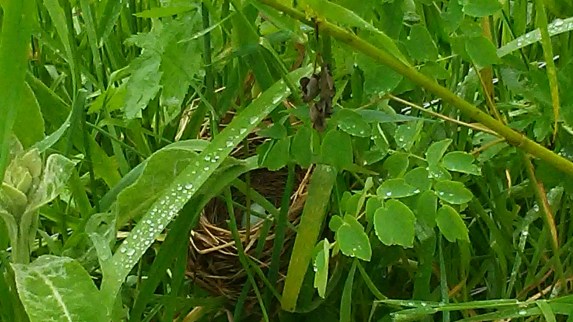
There it was . . . a red-winged blackbird’s nest.  There was the alarm going off as the mother told me in no uncertain terms to get away as I approached the nest.  Yes, of course . . . but . . . let me take a look first.  I got close enough to see one egg, and there could have been more.  The nest was built into the fence.  I had heard they built their nests close to the ground.  It would seem safer in a tree.  But, these birds know more than me.

The other day, the cows were munching oh so close, I thought for sure they would destroy the nest, as I went on my jog.  When I got back, the cows were gone, and the nest was intact.  So, I kept an eye on that nest each day.  I was so delightedly to find it.

But, as Nature has it, I approached it the other day, and no alarm.  I took a closer look . . . and no egg.  That was a sad moment.

They Are Just Strawberries

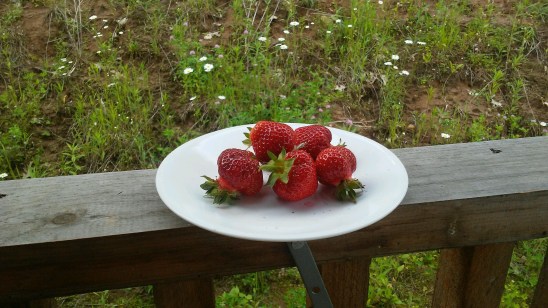
Strawberries

It’s a new life for me, this off grid thing.  It is just about two years old now.  I am truly loving it.  Adventures around every corner . . . for me.  Others may not have an interest or care.  They may wonder at my delight in each new discovery . . . and roll their eyes.  But, when I started this new life, I wondered what we compromised by going down “technology road.”  Living the life of extreme convenience has its price.  And, people scowl at the notion of “going back” . . . heaven forbid we go back.

Don’t get me wrong.  There are things I definitely don’t want to give up.  Like the Internet . . . and my cellphone.  And, as much as I have shifted away from conveniences, I still use them . . . like the car . . . and the grocery store.

But this lifestyle has me convinced about going “back”.  Some moments, while sitting and listening to the symphony of birds and gazing at the ridge across the valley . . . fully green . . . and just slipping into summer, I feel myself melt into it all.  I am just as much a part of the trees and the songbirds singing as my body is sitting in the chair.

garden

Discoveries abound.  My garden is doing better this year.  It is flourishing . . . well, the yield will truly tell.  I look at it every morning to see what is growing and how it is progressing.  Overnight, the beans literally poked through the earth.  Well, and as soon as those bean got to an eatable height, the deer ate them.  I was so proud of those beans.  Last year they hardly came up.  A friend said just replant them.  So this adventure doesn’t come without detours.

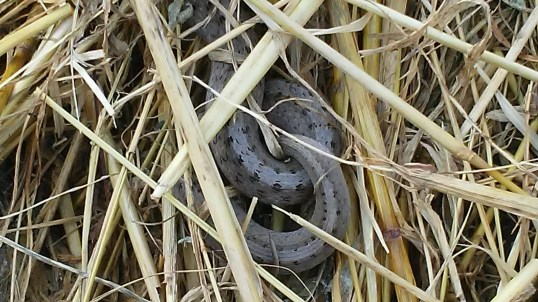
brown snake

This year, there are so many more snakes.  Yes, I am not totally loving them . . . but then again . . . they are interesting.  As long as they are not poisonous.  I bought 10 bales of straw to use for mulch to keep the soil moist and help revitalize the soil.  There is a whole family of garter snakes in that stack of bales.  Then, I found a little DeKay’s brown snake sunning itself on top of the bales one day.  It is in the picture above and quite small.  A corn snake was sitting under a piece of wood in the wood shed.  So far, most of them are not that big.

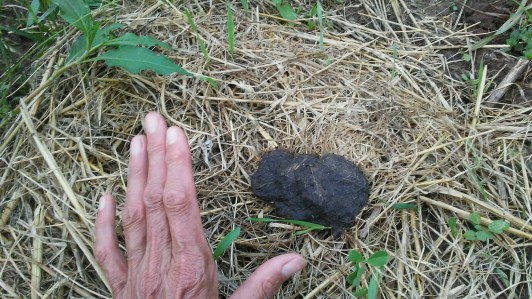
bear scat

Then there is the scat.  That is the term for animal “poop.”  You may not have actually wanted to see a picture of it.  Oh, well.  Indigenous tribes paid close attention to this, I am sure.  It meant food or survival.  I just don’t want to step in it.  There is a pile of scat in my vegetable garden . . . that could be from a bear.  I looked up all the possible characters that could have deposited it but none came close.  A friend said that some animal could have had a digestive episode.  Hence, why it was a big pile instead of formed.  The guy who delivers my wood said the DNR tracks animals.  If it is indeed from a bear, I am sure they would want to know about it.  There have been a few spotted in my area.  It is just not that common this far south in WI.

But, back to my strawberries . . . I am enthralled.  But, they are only . . . strawberries.  Eaten many times . . . but not from my garden.  And, they are sweet!

I like this going “back” thing.

“Canadian Permafrost Thaws 70 Years Early”

This is the title of Matthew Green’s article in Reuters, June 18, 2019, attached below.

https://www.reuters.com/article/us-climate-change-permafrost/scientists-amazed-as-canadian-permafrost-thaws-70-years-early-idUSKCN1TJ1XN

“Thawing permafrost is one of the tipping points for climate breakdown and it’s happening before our very eyes,” said Jennifer Morgan, Executive Director of Greenpeace International. “This premature thawing is another clear signal that we must decarbonize our economies, and immediately.”

The reason that this is devastating is that there is methane under the permafrost.  It is a highly concentrated greenhouse gas, and it will be released as the permafrost thaws.  This will warm the planet even more.

And, these types of articles come every other day.

Yes, it is scary.  We are here . . . climate emergency is here.  The planet is a big place.  The warming has changed slowly, as have the ramifications of that warming.  But, now, things are a bit more noticeable . . .  and, we still go about our lives as if everything is normal . . . but it is not.

A friend is going to Berkeley at the end of June, and San Francisco was 103 degrees a week ago.  Unbelievable!  Here in the Midwest, it has rained so much that the farmers are just planting or will not be planting because it is too late.

Yes, sea levels will rise, and people will have to move.  But the biggest threat to our survival is that when it is too hot or there is too much rain, it threatens our food source.  If you really want to worry about this climate emergency, worry about how we are going to grow food or if we will be able to.

But . . . there is hope.  Because of the global climate movement that happened to converge this year with the Sunrise Movement, Greta Thunberg, Extinction Rebellion, the global student strikes, Ende Gelaende, Our Children’s Trust, and all the other groups, many that we have not heard of yet, they are all working tirelessly to save our planet.

And . . . I can’t believe how many times I have mentioned some of these groups, and friends have never heard of them.

Well, they know them now!

We are all working for a Green New Deal or some plan that will drastically change the way we live to turn climate change around.  Scientists say we have to leave 80 percent of the fossil fuels in the ground now.  Think about that for a moment.  Think about what that means and how our way of life will be altered.

It could be a very good thing.  It could actually slow us down . . . and bring us together.

Personally, I don’t care what it costs.  There is money to be had.  Look at everything that is subsidized and our military budget.  Forget what type of economy . . . or if we even have an economy when the dust settles.  Our survival is at stake.

Let’s just get this done . . . and now.

And, what is in our way?  A bunch of billionaires that can’t possibly spend all the money they have.  I say take all of your marbles and go home.

As the Cree Indian proverb says, “Only when the last tree has died, and the last river been poisoned, and the last fish been caught, will we realize we cannot eat money.


Sometimes You Get Lucky

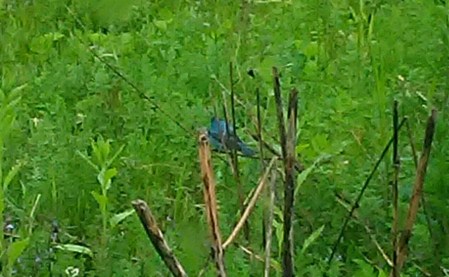
Indigo bunting

I have heard of them . . . the indigo buntings.  I never really thought I would see one . . . let alone twice!  Yes, it is just a bird . . . but what a beautiful bird.  Living closer to Nature is one of the reasons I moved here.  Just this summer alone, I have been lucky to see baltimore orioles, grosbeaks, and bluebirds, along with the indigo buntings.  Baltimore orioles actually made a nest in the woods behind my cabin.  That orange is so vibrant.  Unbelievable!  And, now I know its song.

Most of the birds don’t get too close so this picture doesn’t display the indigo’s beauty.  Well, if I had a bird feeder, it would bring them in closer.  But then, it would also bring in hawks, which I don’t want.  I am not crazy about the food chain.  Yes, they all have to eat . . . but I don’t want to see it in action.  That is one of the reasons I am a vegetarian.  Not possible for some of those other creatures out there.

There are the usual cast of characters that were in IL:  the cardinal, robin, black-capped chickadee, blue jay, crow, sparrow, cat bird, yellow finch, wren and any others I have forgotten are all here, too.

I used to think the robin had the best song . . . I don’t know anymore.  Some little, seemingly incidental, brown bird has a very cool song.  It may just bump the robin’s song out of the top.  Then again, if you have ever heard the cat bird . . . well, that has to be in the running, too!  No need to put any music on while basking in the sun eating breakfast . . . there is a symphony going on all around.

I just count myself very lucky!

Garden Progress

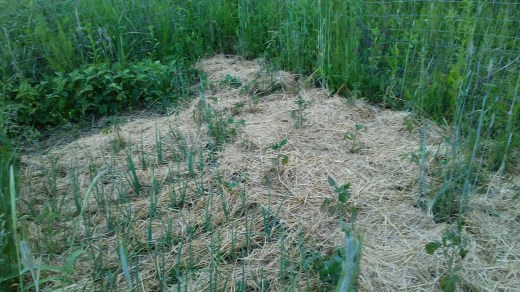
Tomatoes and strawberries

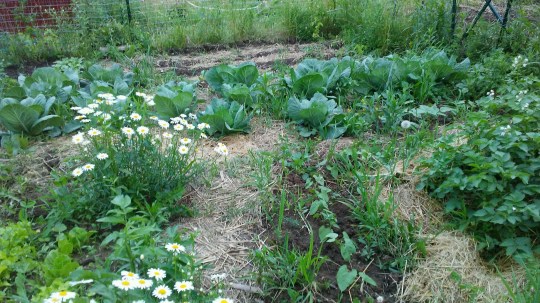
Here is my garden update. Growing here are my tomatoes, strawberries, and onions.  The soil is in need of repair so I was able to find organic strawbales, which was no easy task, by the way.  I am using them to mulch, hold moisture, and they will also amend the soil.  This is, again, all new to me.  I am not an expert at this at all.  The strawberries, in the back, are doing well.  Except, they do have some spots on the leaves.  But, there are plenty of strawberries, and I just planted them last year.  The tomatoes and onions are holding their own.

Cabbage

Above are my potatoes, cabbages, and beans.  I also planted radishes, garlic, lettuce, spinach, and kale but are not visible here.  The spinach has not come up yet and it has been at least 14 days.  Maybe it has been too cool or not enough watering.  I don’t know.  Time will tell how well they do.  Last year was not a good year for yield.  I will keep trying until the soil improves.

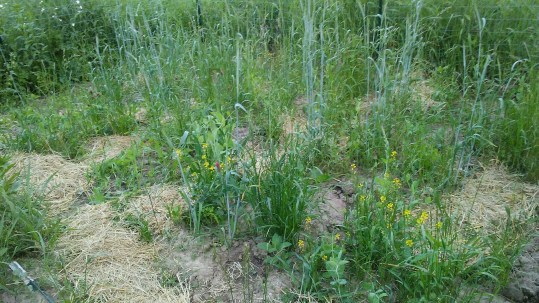
Cover crop

This plot has all my vining plants; cucumbers, squash, cantaloupe, watermelon, and asparagus.  Well, asparagus is not vining.  I planted cover crops, which is what you can see, as the veggies only have two leaves and are not visible.  There may be a mixture of some grasses with the cover crops.  I will cut these down and add more straw.  Again, this soil isn’t going to be amended overnight.  It may take several years to really get it producing but I can wait.  It is a learning process.

I bought three more Concord grape plants that are very healthy looking and have grapes on the plants already.  In addition, two more blueberry plants will be added to the three I already have.  The deer ate much of the three that were already in from last year.  More fencing needs to be added.  Two more gooseberry bushes joined the one from last year.  Two peach trees are also new and another raspberry bush replaced one that didn’t make it.  Of course, I am hoping all of these produce.

XR Madison at Ride the Drive

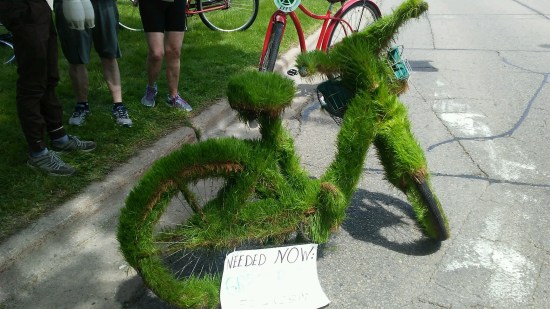
Grass bike

Yes, your eyes do not deceive you.  It is a bike covered in growing grass.  Our Extinction Rebellion (XR) Madison group took part in Madison’s Ride the Drive, Sunday, June 2.  The sign, if I remember correctly, says, “Needed Now, Grassroots Activists for Climate Change.”  It got attention for sure.  One of our members had this idea and put it together . . . and everyone wanted to see it and take a picture.  It was a great way to bring people in so we could talk to them about the climate crisis.  We were able to get some new members.  Our group is new so it will take some time to build our numbers up for some direct actions in the future.