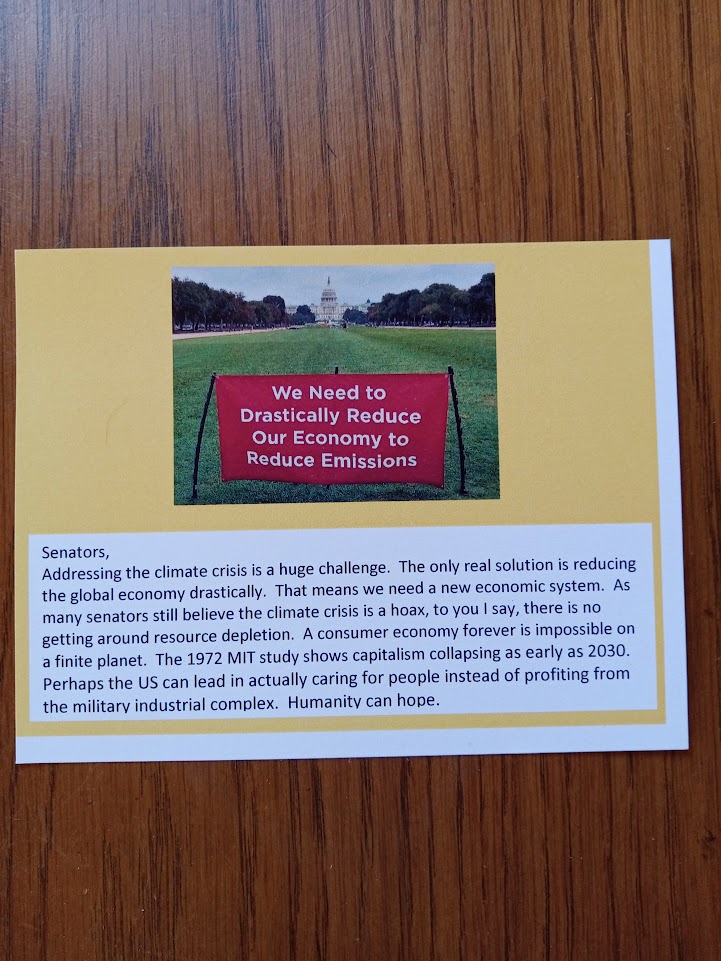
As drastic as that sounds, it is what we need to address the climate crisis. And, although planetary collapse due to the climate crisis is inevitable or is happening as we speak, action can still be taken to avert some suffering. The same global shutdown that occurred during Covid needs to happen now but with some additions. In the US, Big Box Grocery stores with all its processed food and retail never shut down. We need only local, unprocessed food, along with reduced beef and dairy. A debt jubilee and annual income need to be implemented.
Because this is unfolding slowly, people, governments, and businesses do not see the urgency.
In the documentary “How Cuba Survived Peak Oil,” they were forced to change because oil was not coming from the Soviet Union anymore because of the collapse. They started growing food everywhere. This is what we need to do. We can imagine a new way to live locally without all the consumer goods we have been used to.
Also, the documentary “The Year the Earth Changed,” shows how during the global shutdown, the Earth was rebounding. Please watch both documentaries. We need to have some medical for people but not much else.
Shutdown the consumer economy before the Earth shuts us down. As impossible as this seems, that is what needs to happen. Industrialization is killing us.
We can imagine a much better world to live in without all this stuff.
The Economics of Happiness is a documentary by Helena Norberg-Hodge. It is an all-encompassing film for me that shines a bright light on how to deal with the climate crisis. It has much more to say about how we live than just let’s not burn fossil fuels anymore. Helena comes to visit a village in Tibet, and over the course of some 35 years, witnesses a way of life that is rich and very different from the Western world she knows. She sees the transformation after the Pepsi truck comes to town in the form of consumerism. What was once a vibrant people proud of their song, dress, and way of life is destroyed by the consumer economy. It is a film well worth watching.
Attached is an interview hosted by Nate Hagens with Bill Rees. This interview is a must if you don’t know what Overshoot is. Even if you do, it is well worth watching. Overshoot basically means we are using more resources than the planet can regenerate or won’t be able to regenerate. When some resources like oil are gone, they are gone. This is something that economists have never wanted to take into consideration, as Bill explains.
Attached is the recent interview by Nate Hagens with Arthur Berman, “Peak Oil – The Hedonic Adjustment.” You may or may not be familiar with the term peak oil. Regardless, this interview is a must. Many have debunked peak oil or at the very least kicked the peak oil can down the road. My definition for peak oil is the half way of oil reserves in a country or globally. Obviously, the remaining half of the oil will be depleted much more rapidly than the first half due to the increase in population and the additional uses for oil.
I always say that if they are trying to get oil out of tar sands, the end of oil is not that far away. If you are not familiar with tar sands, look up Alberta Tar Sands. And, as clearly stated in the interview, oil runs the whole global economy. Art Berman discovers some important and disturbing facts while getting ready for this interview. Spend some time and watch this. It is important that people know these things and are prepared. Please share it. Thank you.
There is nothing scarier to the majority of scientists . . . and me . . . than geoengineering. For anyone that is unfamiliar with that term, it is the process of spraying sulfur dioxide into the atmosphere to keep the sun from warming the planet. Shannon Osaka wrote an article in the Washington Post on January 9, 2023, called, “This firm is working to control the climate. Should the world let it?”
Osaka reports that regardless of the risks, Luke Iseman, the founder and CEO of Make Sunsets, is acting on his own without any world decision to go ahead with geoengineering experiments. He is going to make that call for the whole world? Granted he is doing it on a small scale but that is not some decision I personally want him trying out on the planet. He will then encourage others to do the same.
That turn at the Industrial Revolution created this climate crisis. Should we trust some geoengineering technology to fix it?
No one knows how this will turn out. Industrialized nations are pushing to do something drastic, as levels of CO2 continue to rise, and geoengineering is looking like their solution. I will tell you what drastic is but guaranteed to work to keep CO2 from rising . . . shut down the consumer economy for starters. What geoengineering says as a solution is the fossil fuel industry and the consumer economy have no intention of shutting down. Their solution is to keep business as usual.
During March through May 2020, here in the US, a big portion of the economy was shut down because of COVID. Everything from retail, restaurants, schools, theaters, etc. were closed. The only exceptions were grocery and hardware stores, and of course hospitals. Emissions declined not immensely but noticeably. Big Box Grocery stores remained open, so that meant the 30% of emissions from our food system kept rolling out. Those stores have a big portion of retail in them, as well.
Sure, shutting down most of the consumer economy will create massive job losses. But you know, we will just have to figure that out. The future of humanity is at stake. Everything we rely on to keep us alive is at stake, oh by the way. We need to envision a new way to live, like growing our own food, canning fruits and vegetables, sharing tools, and creating more efficient dwellings that don’t rely on fossil fuels to heat and cool them.
Here in the US, we don’t need 40 different cereals to choose from. Let’s all eat oatmeal for breakfast. We also don’t need to grow tomatoes in Mexico that hitchhike on ocean freight to China to become tomato sauce to then hitchhike back via ocean freight to the US to be transported via semi-truck to distribution centers and finally your local Big Box Grocery store shelves all across the nation. We can grow our own tomatoes.
Stop the insanity of industrialization that is creating the climate crisis and extreme weather, soil depletion, droughts, massive flooding, land disruption, warming oceans, methane release from thawing permafrost, mowing down the Amazon for more food for animal agriculture, mining, resource depletion, and biodiversity loss that will push humanity off the cliff.
Civilizations have collapsed before, . . . and, we are on our way. Can we lessen the blow?
Osaka, Shannon, The Washington Post, January 9, 2023, “This firm is working to control the climate. Should the world let it?”
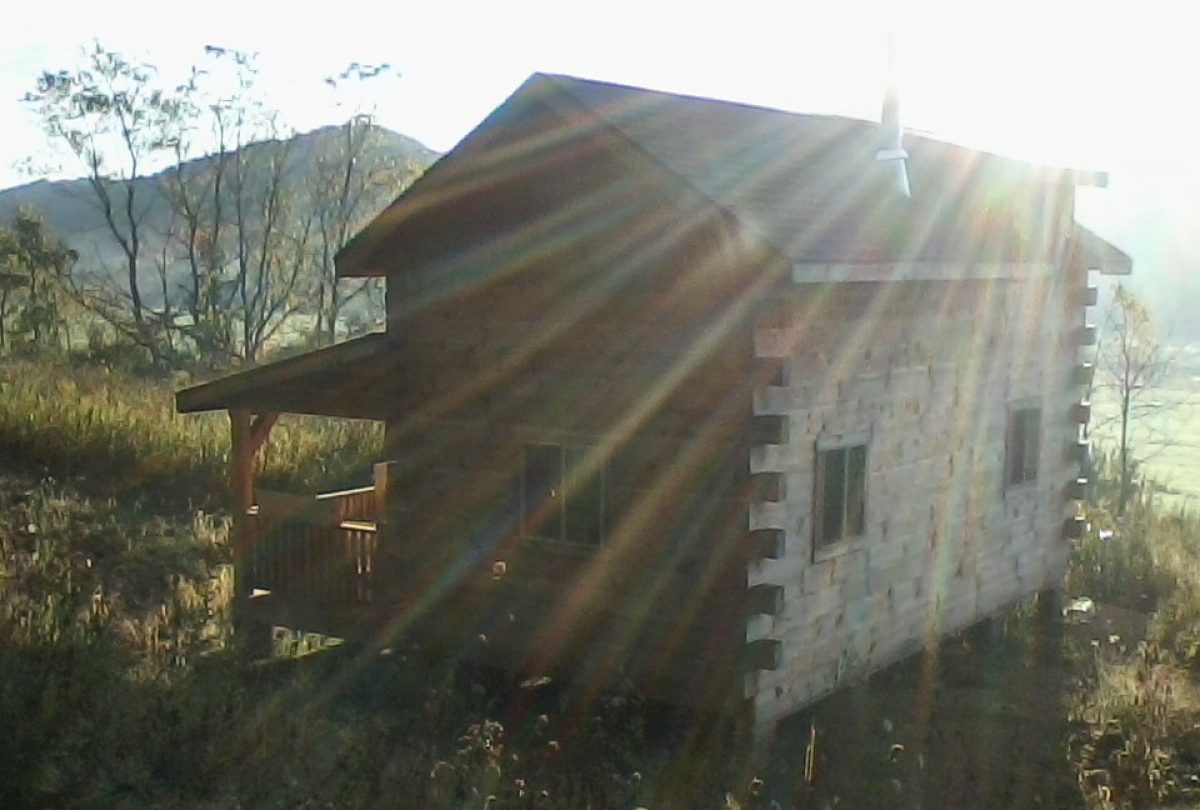
On occasion, I have written about this feeling before. Perhaps more so when I first moved into my little cabin. But, every time I go out to gather kindling . . . I get the feeling again.
To me . . . it is something intrinsic to our nature. It is primal. And, we have lost it. It has been replaced by fluorescent lighting, piped in music, and shelves upon shelves of fossil fuel laden food and products.
Yes, I still have to go into the big box grocery store and drive a car . . . the fossil fuel list goes on. But, yesterday, as I was gathering kindling, that grocery store, etc., felt so unnatural . . . I am caught in between.
I carry on with my goal . . . to be as self sustaining as possible. Even when I hear people say . . . there is no way you can grow all your own food . . . or it is so much work. I say . . . the planet depends on me succeeding . . . and . . . my survival is at stake . . . not to mention the reconnecting of my inner being to what it knows is real . . . Nature, it is home. People have done this in the past . . . and are doing it today.
With persistence, I will learn how to grow my food. Last year, so much went wrong in that garden that will teach me what to do better this year. Yes, the cabbage heads didn’t show up, the potatoes were tiny, the pole beans didn’t come up, onions were too small, carrots and beets are so much trouble, and let’s add broccoli and brussel sprouts to that list, too.
But . . . I got 19 pint jars of canned tomatoes . . . and . . . that meant everything to me.
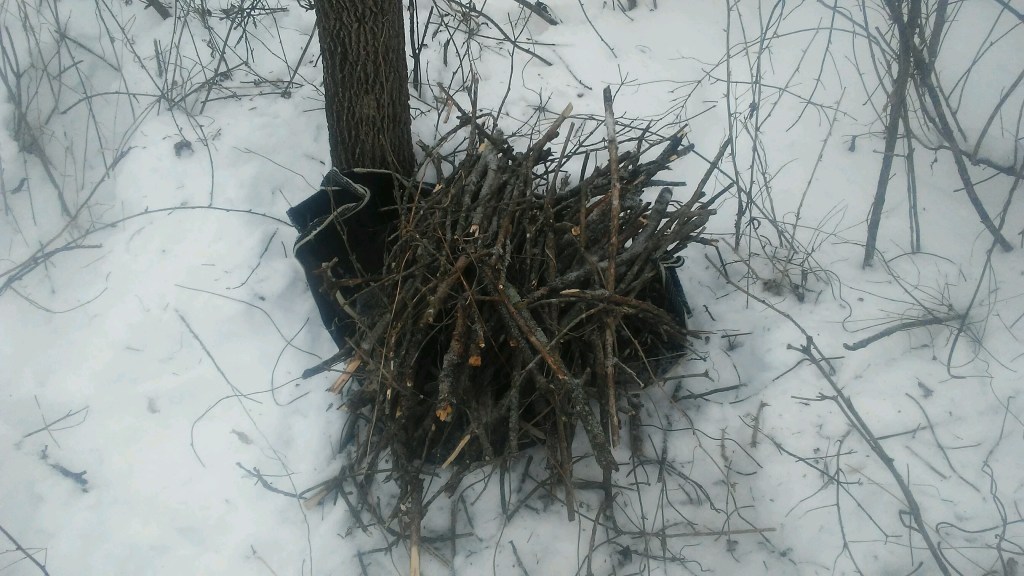
So, kindling . . . it helps start my fires in the wood stove . . . so I can survive the -40 that Nature dishes out. It is a hand to mouth thing. It is not covered in plastic wrap that I need scissors to get into.
My boots sunk into the foot of snow, as I trudged through to an area of trees . . . and watched a rabbit scamper through the field to the other side of the woods . . . heard the snap of each dry branch as I added them to my pile . . . felt the falling snow on my face . . . wondered what kind of shelter I could build in the nook of some trees . . . heard the silence of the gray day . . . enveloped in a milky winter sky . . . felt the knowing eyes of the ancestors guiding me.
If you haven’t see this documentary, get it on your list. The film was directed by Faith Morgan and released by The Community Solution in 2006. It is very inspirational, and it is a great guide to navigating collapse. Believe me, we are going to need it because the collapse is starting to rear its ugly head big time and will only accelerate.
Back in 1991 when the Soviet Union was falling apart, Cuba lost oil imports from them. There was no shooting and chaos because of it, as many here in the US fear will take place when collapse happens. Instead, the power of community shone brightly, and everyone came together. Without oil, the country stopped. Buses ran intermittently. They said the average Cuban lost 20 lbs. Eventually, everyone was growing food everywhere. Oxen were used to plow fields. Very little fertilizers or pesticides were used if any. I highly recommend watching it.
A little note here about the reference to peak oil in the title of the documentary for people who are not familiar with that term. Peak oil is when a country or globally the half way point of oil is reached. The US reached peak oil in the 1970s. Well, then, horizontal fracking was invented, and the oil that was unreachable was extracted. I ran into a site on the history of oil, and the US stopped exporting oil when it reached peak oil to protect reserves. That lasted for 40 years until fracking came along.
A big oil boom happened around 2005 or so. Back then, everyone was moving to North Dakota to get an oil job at the Bakken Oil field. Fracking for natural gas happens in many states but there are about only four major oil fields in the US that use fracking. Michael Patrick Flanagan Smith wrote a great article on what that oil boom was like when he worked there from 2013 to 2014. People were living in their cars because the town had no place to house everyone. The peak oil term got kicked down the field because everyone thinks we will always find ways to extract more oil, even though we can’t afford to burn another drop. Since then, those oil fields are running dry.
I always say, if they are spending money to extract oil from Alberta tar sands, which is gunk, the end of oil is not far away. And, as Cuba witnessed, oil runs everything.
While Cuba had no warning that crisis was coming, the climate crisis alarm has been blaring finally for the last three years. Countries have been coming together since 1992 to address the climate crisis but it really didn’t hit center stage until Greta Thunberg showed up shortly before COVID lambasting world leaders at the COP24 meeting in Poland in December 2018 for doing nothing. Just listening to her again in the link below brought tears to my eyes.
The climate crisis has moved at a snail’s pace. So where is the urgency? Well, things are starting to ramp up.
I am wondering if there are any more forests in the US left to burn? Every season millions of acres go up in smoke. Because of drought, the Danube River in Germany was so low this summer that they couldn’t use it for exporting goods. China closed factories this past summer because of drought and heat. The Colorado River in the Southwest US is in the 23rd year of a major drought. Seven states depend on water from the Colorado, and 70% of it is used for agriculture. Farmers are letting fields go fallow because a lack of irrigation. Places like Portland and Denver that don’t normally get summer temperatures in the 90s and 100 got hit again this summer. Hurricane Ian slammed Florida. These are just a sampling of how the climate crisis is playing out. There are countless other examples worldwide, of course.
Where does this leave us? What does this film tell us? What can we do?
It is clear that the US and other countries are hell bent on squeezing the last dollar from the economy and pillaging the resources until the planet is ravaged of the last thriving ecosystem. The CEOs and politicians will be safely tucked away in elaborate bunkers stocked to the hilt to watch us fend for ourselves knowing they have sold us enough misinformation, fear, and guns.
Hmmm. Perhaps the power of community that Cuba exhibited will radiantly emerge.
We can hope.
The Power of Community: How Cuba Survived Peak Oil
Never heard of it? You are not alone. It is anything but Mainstream. Google doesn’t even send me anything on it, and it is really good at sending me climate crisis news. Well, and, it is a pretty radical solution to the climate crisis, but . . . the most realistic. I have written about it before . . . but let’s go here again.
Degrowth needs some serious PR right now. People need to be talking about this. It won’t be an easy transition but it is doable. And, did I mention, we will need some new kind of economy . . . or maybe no economy. The people up at the top, the corporations and politicians, well, and also small businesses, are not going to go for this. They are not addressing the climate crisis at all now, anyway. They are too busy taking humanity off the cliff.
Yes, everyone can switch to renewable energy, but . . . I am sorry to tell you, that has its own issues environmentally. Right now, we are basically focusing on our own energy needs and forgetting about the big emission producer, and, that is . . . what we consume in the way of products and FOOD every day!
So what is Degrowth all about? When you start counting all the CO2 a product produces, meaning all the embodied energy, you are on your way to understanding why Degrowth makes sense. By that time, when you go into the Big Box Grocery store, your head will want to explode seeing all that CO2 on the shelf.
If you are not quite there yet, let’s take a walk through the cereal aisle. That innocent raisin bran sitting on the shelf had a big diesel tractor plant the wheat and harvest it, took it to a flour mill, trees were cut down for the box, oil was extracted for the plastic sleeve, raisins were grown and harvested, the box went to a printer to have the graphics printed, and all of it ended up at the raisin bran factory so it could be shipped to your local store. That took a lot of CO2.
Now, look at every product on the shelf and go through that same process. It takes oil to transport and electricity, heat, and AC for those manufacturing plants. Do we really need 40 different cereals? How about oatmeal for breakfast out of a bin reusing your own bag. Ah, now, we are getting somewhere. Remember, when you pick a tomato from your garden, there is no CO2 emitted. Don’t have a garden? Get a garden plot.
Maybe you are thinking about all the jobs that will have to go. I don’t know about you, but I want to live. That is what this whole thing is about . . . surviving. And, at this point, if you are watching the game, we are very close to losing. Maybe we will just reduce the suffering that is headed our way.
A debt jubilee, universal income, not to mention garden plots everywhere, are all many of the ways we can do Degrowth. Just think of all the things that emit CO2 or use lots of water that we can live without and still be happy. Think about it . . . talk about it at the dinner table . . . and, pass it on. Degrowth.
 An Off Grid Life - Climate Crisis Solutions